The Day Culture Walked Out the Door: Culture as a Competitive Advantage
By: Danaira Rodriguez, Junior Marketing Advisor, DuartePino
I didn’t understand what culture was until I watched it walk out the door.

She was my first real manager in the corporate world, and I grew up professionally on her team. I got lucky in a way most people don’t at the start of their careers.
Our one-on-ones actually meant something. Her feedback was specific and kind at the same time, which is harder than it sounds. She recommended books, explained the reasoning behind decisions, and made time for my development even when she had none to spare. She documented everything. She had done the work to become that kind of leader, and our small team ran on it.
I loved that team. Then she left.
Same Title, Double The Job
Nobody else knew her work. The one teammate doing anything similar had just started, and our director was away for a month.
So I picked it up. Same junior title, same pay, most of her workload, plus training that new teammate on everything she had taught me.
Her documentation saved me. She had prepared me for that moment without either of us knowing it. But her notes could only tell me how to do the work. They couldn’t tell me what to prioritize, or shield the team from pressure the way she always had.
I kept asking when help was coming. It took months, and the new leader who finally arrived wasn’t the fix any of us had hoped for. He was a kind person. He just never found his footing, and the weight stayed with me. Eventually, tired and out of options, I left without another job lined up.
About a year later, over coffee with the teammate I had trained, I learned the new leader had been let go, and the team had been reorganized more than once.
At the time, nobody would have called any of this a culture problem. It looked like a staffing gap, then a hiring miss, then a reorganization. But underneath was the same thing: the person who held the team together was gone, and nothing had been built to carry what she carried.
Culture Is Load-Bearing: Why It Can’t Depend On One Person
Anyone who has renovated a house knows you don’t always find out which wall holds everything up until you take it down.
My manager was a load-bearing wall. The trust, the standards, and the way the team felt on a Monday morning didn’t live in a values statement. They lived in her. Culture, I learned, isn’t what a company says about itself. It’s how people work, decide, and treat each other when nobody is checking. In hindsight, she was carrying all of it and quietly burning out, the same way I would later. She just never let it show.
Most leaders never plan for that risk, because it doesn’t look like one. When culture depends on a single person, it’s only as stable as that person’s decision to stay.
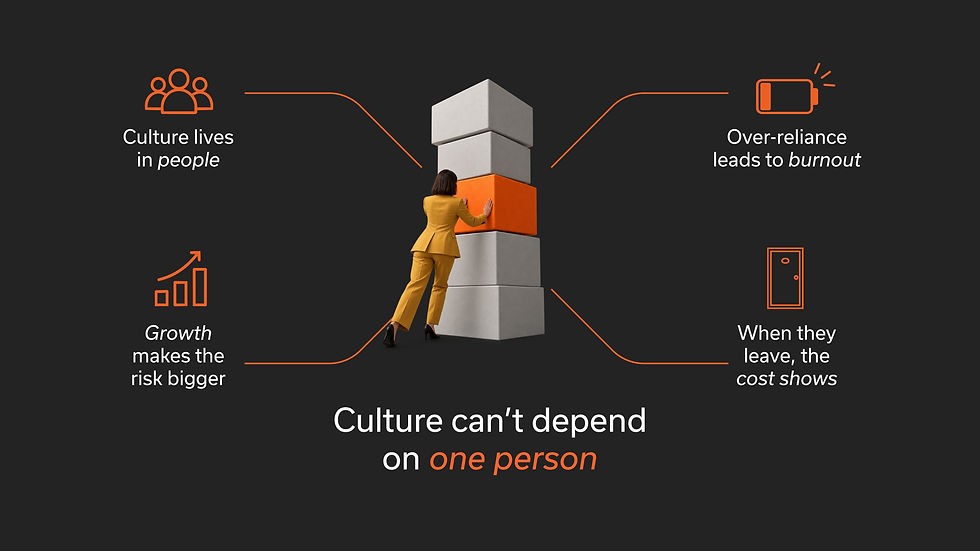
Scale-ups are full of these walls, and often the biggest one is the founder. In Puerto Rico, where so many companies still carry a family name, that is especially true.
In the early days, the founder’s judgment and relationships hold everything together, and that works with a team of 15. But at 50 or 150, the founder can’t be part of every conversation anymore. Whatever lived only in their head, and never made it into how the company hires, makes decisions, and develops its people, starts to crack.
The Cost Nobody Saw
I don’t think anyone decided to burn us out. Every decision made sense on its own: good hires took time, budgets were tight, and the work was still getting done. That was the trap. Because the work kept getting done, nobody saw the wall cracking. Someone was always holding it up, first her and then me.
That’s how culture erodes in growing companies: a series of reasonable decisions made without asking who is absorbing them. By the time it shows up in the numbers, the people who felt it first are already gone.
Find Your Walls Before They Move: Culture As A Competitive Advantage
If you lead a growing company, don’t wait for a resignation letter to find out where your culture lives. Ask who your organization quietly runs on. Not necessarily the biggest titles, but the people everyone goes to. If one of them left tomorrow, what would break that isn’t written down anywhere?
Then look at your last decisions about those people: their workload, their pay, who backs them up. Those say more about your culture than anything on the wall, and your team is watching them more closely than you think.
I still run into my old manager now and then, and I always tell her the same thing. She shaped the professional I became, and I still carry her habits into every team I work with. Her culture outlasted her in me. It just didn’t outlast her in the company.
Culture as a competitive advantage isn’t about having someone like her on your team. It’s building a company where, when someone like her walks out the door, the culture doesn’t walk out with her.
––––––––––
ABOUT DUARTEPINO
DuartePino is a management outsourcing firm that combines deep customer knowledge with practical expertise in marketing, communications, and brand management to drive sustainable growth for clients. Our network of Trusted Advisors brings years of experience, offering fresh perspectives, proven processes, and the martech tools needed for effective execution.
In addition to our core services, we have expanded through our ventures, Téntico a strategy-first brand studio focused on authentic branding for legacy brands and scale-ups. And Haipriori, specializing in custom software solutions and digital innovation. We manage over 15 marketing communications departments, representing over $1B in annual sales, with 70% of clients exporting to international markets.


Comments